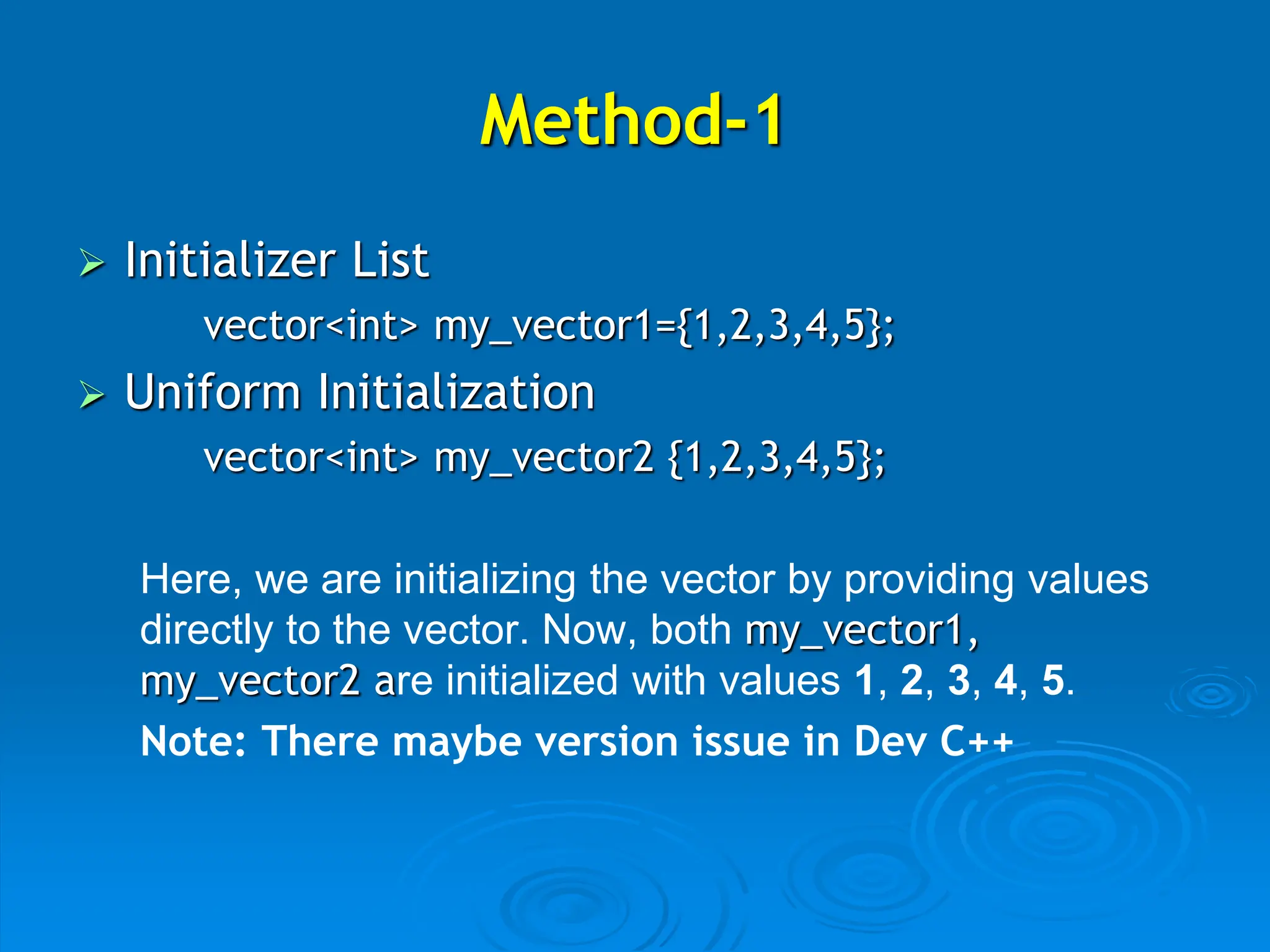
In the realm of C++ programming, efficiency and clarity are paramount. One feature that significantly enhances both is the Cpp Initializer List. This powerful construct allows developers to initialize objects in a concise and readable manner, making the codebase cleaner and more maintainable. Understanding and effectively using Cpp Initializer List can greatly improve the performance and readability of your C++ programs.
Understanding Cpp Initializer List
The Cpp Initializer List is a feature introduced in C++11 that provides a way to initialize objects using a list of values. This is particularly useful for initializing containers like vectors, maps, and other standard library types. The syntax is straightforward and intuitive, making it a favorite among developers for its simplicity and readability.
Here is a basic example of how to use a Cpp Initializer List to initialize a vector:
#include
#include

int main() {
    std::vector vec = {1, 2, 3, 4, 5};

    for (int i : vec) {
        std::cout << i << " ";
    }

    return 0;
}
In this example, the vector `vec` is initialized with the values 1 through 5 using a Cpp Initializer List. This method is not only concise but also ensures that the vector is initialized with the specified values.
Benefits of Using Cpp Initializer List
The Cpp Initializer List offers several benefits that make it a valuable tool for C++ developers:
- Readability: The syntax is clean and easy to understand, making the code more readable.
- Efficiency: It allows for efficient initialization of objects, reducing the need for multiple lines of code.
- Flexibility: It can be used with a wide range of data structures and types, including user-defined types.
- Safety: It helps prevent common initialization errors, such as uninitialized variables.
Using Cpp Initializer List with User-Defined Types
The Cpp Initializer List is not limited to standard library types; it can also be used with user-defined types. To do this, you need to define a constructor that accepts an initializer list. Here is an example:
#include
#include

class MyClass {
public:
    MyClass(std::initializer_list list) {
        for (int value : list) {
            data.push_back(value);
        }
    }

    void print() const {
        for (int value : data) {
            std::cout << value << " ";
        }
        std::cout << std::endl;
    }

private:
    std::vector data;
};

int main() {
    MyClass obj = {1, 2, 3, 4, 5};
    obj.print();
    return 0;
}
In this example, the `MyClass` constructor takes a Cpp Initializer List of integers and initializes a vector with these values. The `print` method then outputs the values stored in the vector.
💡 Note: When using Cpp Initializer List with user-defined types, ensure that the constructor is properly defined to handle the initializer list.
Cpp Initializer List with Standard Library Containers
The Cpp Initializer List is particularly useful with standard library containers. Here are some examples of how to use it with different containers:
Vector
A vector can be initialized with a Cpp Initializer List as shown earlier. This is a common use case and is highly efficient.
Map
A map can also be initialized using a Cpp Initializer List. Each element in the list is a pair of key-value pairs.
#include
#include Set
A set can be initialized with a Cpp Initializer List of values. This is useful for creating sets with predefined elements.
#include
#include

int main() {
    std::set set = {1, 2, 3, 4, 5};

    for (int value : set) {
        std::cout << value << " ";
    }

    return 0;
}
Performance Considerations
While the Cpp Initializer List is convenient and readable, it is also important to consider its performance implications. In general, using a Cpp Initializer List is efficient, but there are some scenarios where it might not be the best choice. For example, if the initializer list contains a large number of elements, the performance might be affected due to the overhead of copying or moving elements.
To mitigate this, you can use move semantics to transfer ownership of resources efficiently. Here is an example:
#include
#include

class MyClass {
public:
    MyClass(std::initializer_list list) : data(list) {}

    void print() const {
        for (int value : data) {
            std::cout << value << " ";
        }
        std::cout << std::endl;
    }

private:
    std::vector data;
};

int main() {
    MyClass obj = {1, 2, 3, 4, 5};
    obj.print();
    return 0;
}
In this example, the `MyClass` constructor uses move semantics to initialize the `data` vector, which can improve performance when dealing with large initializer lists.
💡 Note: Always consider the performance implications of using Cpp Initializer List, especially when dealing with large datasets.
Best Practices for Using Cpp Initializer List
To make the most of the Cpp Initializer List, follow these best practices:
- Use for Initialization Only: The Cpp Initializer List is primarily meant for initializing objects. Avoid using it for other purposes, such as modifying existing objects.
- Prefer Move Semantics: When dealing with large datasets, use move semantics to transfer ownership efficiently.
- Keep It Simple: Use the Cpp Initializer List for simple and straightforward initializations. For complex initializations, consider using other methods.
- Document Your Code: Clearly document the use of Cpp Initializer List in your code to ensure that other developers understand its purpose and usage.
Common Pitfalls to Avoid
While the Cpp Initializer List is a powerful feature, there are some common pitfalls to avoid:
- Incorrect Syntax: Ensure that the syntax is correct when using Cpp Initializer List. Incorrect syntax can lead to compilation errors.
- Mismatched Types: Make sure that the types in the initializer list match the types expected by the constructor. Mismatched types can lead to runtime errors.
- Performance Issues: Be aware of the performance implications, especially when dealing with large datasets. Use move semantics where appropriate.
By avoiding these pitfalls, you can effectively use the Cpp Initializer List to enhance the readability and performance of your C++ programs.
💡 Note: Always test your code thoroughly to ensure that the Cpp Initializer List is used correctly and efficiently.
Advanced Usage of Cpp Initializer List
Beyond the basic usage, the Cpp Initializer List can be used in more advanced scenarios. For example, you can use it to initialize nested structures or to pass initializer lists to functions. Here are some advanced examples:
Initializing Nested Structures
You can use the Cpp Initializer List to initialize nested structures. This is useful when dealing with complex data structures.
#include
#include

struct Nested {
    int a;
    int b;
};

struct Outer {
    std::vector nested;
};

int main() {
    Outer outer = {{{1, 2}, {3, 4}, {5, 6}}};

    for (const auto& nest : outer.nested) {
        std::cout << "a: " << nest.a << ", b: " << nest.b << std::endl;
    }

    return 0;
}
Passing Initializer Lists to Functions
You can also pass initializer lists to functions. This is useful when you want to initialize objects within a function.
#include
#include

void printList(std::initializer_list list) {
    for (int value : list) {
        std::cout << value << " ";
    }
    std::cout << std::endl;
}

int main() {
    printList({1, 2, 3, 4, 5});
    return 0;
}
In this example, the `printList` function takes a Cpp Initializer List of integers and prints each value. This demonstrates how you can pass initializer lists to functions for flexible and efficient initialization.
💡 Note: When passing initializer lists to functions, ensure that the function signature matches the expected types.
Cpp Initializer List and Move Semantics
Combining the Cpp Initializer List with move semantics can significantly improve the performance of your C++ programs. Move semantics allow you to transfer ownership of resources efficiently, reducing the overhead of copying. Here is an example of how to use move semantics with a Cpp Initializer List:
#include
#include
#include

class MyClass {
public:
    MyClass(std::initializer_list list) : data(std::move(list)) {}

    void print() const {
        for (int value : data) {
            std::cout << value << " ";
        }
        std::cout << std::endl;
    }

private:
    std::vector data;
};

int main() {
    MyClass obj = {1, 2, 3, 4, 5};
    obj.print();
    return 0;
}
In this example, the `MyClass` constructor uses move semantics to initialize the `data` vector. This ensures that the resources are transferred efficiently, improving performance.
💡 Note: Always consider using move semantics when dealing with large datasets to improve performance.
Cpp Initializer List and Constexpr
The Cpp Initializer List can also be used with `constexpr` to create constant expressions. This is useful for initializing constant objects at compile time. Here is an example:
#include
#include

constexpr std::vector createVector() {
    return {1, 2, 3, 4, 5};
}

int main() {
    constexpr std::vector vec = createVector();

    for (int value : vec) {
        std::cout << value << " ";
    }

    return 0;
}
In this example, the `createVector` function returns a `constexpr` vector initialized with a Cpp Initializer List. This allows the vector to be initialized at compile time, ensuring that it is a constant expression.
💡 Note: When using Cpp Initializer List with `constexpr`, ensure that all operations are valid at compile time.
Cpp Initializer List and Lambda Functions
The Cpp Initializer List can be used with lambda functions to create flexible and efficient initialization. Here is an example:
#include
#include
#include

int main() {
    std::vector vec = {1, 2, 3, 4, 5};

    std::for_each(vec.begin(), vec.end(), [](int value) {
        std::cout << value << " ";
    });

    return 0;
}
In this example, a lambda function is used to print each value in the vector. The vector is initialized using a Cpp Initializer List, demonstrating how you can combine these features for efficient and readable code.
💡 Note: When using Cpp Initializer List with lambda functions, ensure that the lambda function is defined correctly to handle the initializer list.
Cpp Initializer List and Template Functions
The Cpp Initializer List can be used with template functions to create generic and reusable code. Here is an example:
#include
#include

template
void printList(std::initializer_list list) {
    for (const auto& value : list) {
        std::cout << value << " ";
    }
    std::cout << std::endl;
}

int main() {
    printList({1, 2, 3, 4, 5});
    printList({"one", "two", "three"});
    return 0;
}
In this example, the `printList` function is a template function that takes a Cpp Initializer List of any type. This allows the function to be used with different types of initializer lists, making it highly flexible and reusable.
💡 Note: When using Cpp Initializer List with template functions, ensure that the template parameters are defined correctly to handle the initializer list.
Cpp Initializer List and Standard Library Algorithms
The Cpp Initializer List can be used with standard library algorithms to perform operations on initialized objects. Here is an example:
#include
#include
#include

int main() {
    std::vector vec = {1, 2, 3, 4, 5};

    std::sort(vec.begin(), vec.end());

    for (int value : vec) {
        std::cout << value << " ";
    }

    return 0;
}
In this example, the vector is initialized using a Cpp Initializer List, and the `std::sort` function is used to sort the vector. This demonstrates how you can use standard library algorithms with objects initialized using a Cpp Initializer List.
💡 Note: When using Cpp Initializer List with standard library algorithms, ensure that the algorithms are compatible with the types in the initializer list.
Cpp Initializer List and Custom Containers
The Cpp Initializer List can be used with custom containers to create flexible and efficient data structures. Here is an example:
#include
#include

class CustomContainer {
public:
    CustomContainer(std::initializer_list list) {
        for (int value : list) {
            data.push_back(value);
        }
    }

    void print() const {
        for (int value : data) {
            std::cout << value << " ";
        }
        std::cout << std::endl;
    }

private:
    std::vector data;
};

int main() {
    CustomContainer container = {1, 2, 3, 4, 5};
    container.print();
    return 0;
}
In this example, the `CustomContainer` class is initialized using a Cpp Initializer List. The constructor takes the initializer list and initializes the internal vector with the specified values. This demonstrates how you can use the Cpp Initializer List with custom containers to create flexible and efficient data structures.
💡 Note: When using Cpp Initializer List with custom containers, ensure that the container is designed to handle the initializer list correctly.
Cpp Initializer List and Exception Safety
The Cpp Initializer List can be used to ensure exception safety in your C++ programs. By initializing objects using a Cpp Initializer List, you can avoid common pitfalls that lead to exceptions. Here is an example:
#include
#include

class MyClass {
public:
    MyClass(std::initializer_list list) {
        for (int value : list) {
            data.push_back(value);
        }
    }

    void print() const {
        for (int value : data) {
            std::cout << value << " ";
        }
        std::cout << std::endl;
    }

private:
    std::vector data;
};

int main() {
    try {
        MyClass obj = {1, 2, 3, 4, 5};
        obj.print();
    } catch (const std::exception& e) {
        std::cerr << "Exception: " << e.what() << std::endl;
    }
    return 0;
}
In this example, the `MyClass` constructor takes a Cpp Initializer List and initializes the internal vector with the specified values. The `print` method then outputs the values stored in the vector. By using a Cpp Initializer List, you can ensure that the object is initialized correctly, reducing the risk of exceptions.
💡 Note: Always consider exception safety when using Cpp Initializer List to ensure that your programs are robust and reliable.
Cpp Initializer List and Multithreading
Related Terms:
- cpp member initialization list
- list initialization in cpp
- c initialize list
- std initializer_list in c
- c array in initializer list
- initializer list in c 11